Blog
Interpreting the estimation coefficients of dummy variables in linear regression analysis
Linear regression analysis using the Ordinary Least Squares (OLS) method is the most commonly used technique for examining the influence of one variable on another. There are certain assumptions that need to be met when employing linear regression. Assumption testing is necessary to ensure consistent and unbiased estimation results.
Differences in the use of paired sample t-test and independent sample t-test
The t-test is commonly used to test the mean difference between two samples. The t-test can be performed on paired samples as well as independent samples. When should we use the paired sample t-test and when should we use the independent sample t-test?
Source, Types, and Scale of Data Measurement in Research
Research is an activity that utilizes data to be analyzed, leading to conclusions. In this regard, data is a vital instrument in research. Data represents recorded information about the research.
Data can also be defined as information related to a condition, description, and/or a particular matter. Meanwhile, statistics is the method used to process data to provide information.
Data based on its source and type
Data can be divided into two categories based on its source:
1. Primary Data
Primary data is data obtained directly from the research subjects.
2. Secondary Data
Secondary data is data obtained from other sources, not directly from the research subjects by the researcher.
Data based on its type can be divided into two categories:
1. Quantitative Data
Quantitative data is numerical data that is typically processed using statistical techniques and is objective in nature. Examples of quantitative data include milk production, GDP, GPA, and so on.
2. Qualitative Data
Qualitative data is non-numerical data, often in the form of verbal descriptions or categorizations. It is more subjective in nature and can be represented in the form of rankings for data with an ordinal scale. Examples of qualitative data include some students feeling happy about farming while others do not, the cow being large, the chicken being small, and so on.
Scale of Data Measurement
The types of data measurement scales can be categorized into four:
1. Nominal Scale
The values of the variable only differentiate one category from another. For example, various types of occupations are differentiated only by their categories, without implying that one occupation is better than another.
2. Ordinal Scale
The scale is based on rankings and differentiates the data based on order and levels. For example, levels of education ranked from the highest to the lowest or vice versa.
3. Interval Scale
Data that possesses the characteristics of an ordinal scale but also has known intervals between values. For example, the variable “age” has both value and interval information.
4. Ratio Scale
Data that has characteristics of an ordinal scale but is used to measure distances and weights. For example, the weight of a father is three times the weight of his child.
Guidelines for Data Collection
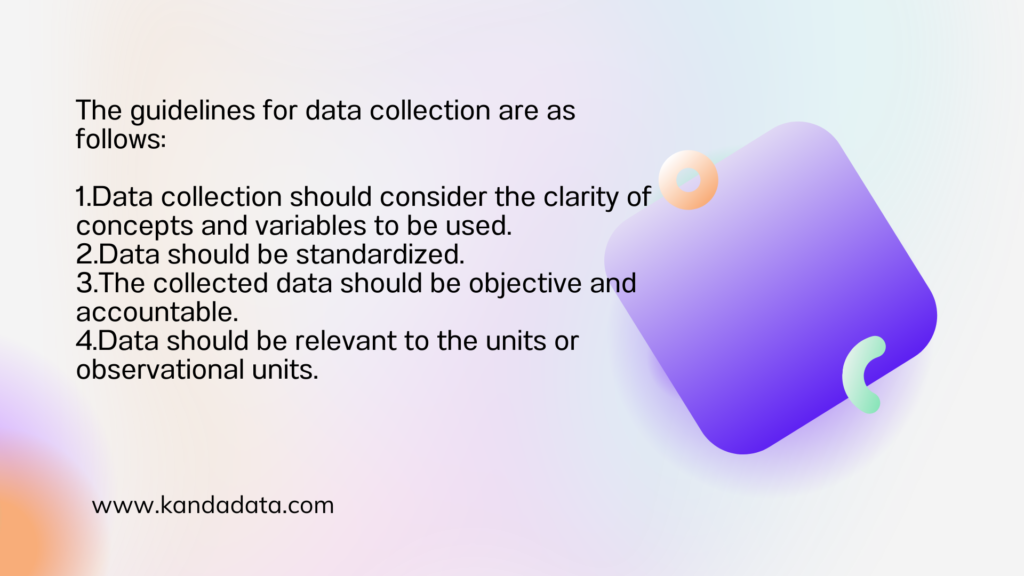
The process of data collection should adhere to data collection guidelines. This is done to ensure that the data used in the research is valid, reliable, and in accordance with scientific principles. The guidelines for data collection are as follows:
- Data collection should consider the clarity of concepts and variables to be used.
- Data should be standardized.
- The collected data should be objective and accountable.
- Data should be relevant to the units or observational units.
Survey and Experimental Research
Research can be broadly categorized into survey research and experimental research based on their implementation. Survey research utilizes and observes existing phenomena, while experimental research generates data through experiments.
Survey research is commonly used in social sciences and sciences. In the field of animal husbandry, surveys are not uncommon, as survey research is commonly employed in studies focusing on the social and economic aspects of livestock.
After conducting data collection in the field for survey research, the next step is data compilation and analysis using statistical tools. These statistical tools can include programs such as SPSS, Microsoft Excel, SAS, and others.
Conclusion
Understanding data is crucial in research activities. Understanding the types of data will determine the appropriate choice of tests. Based on the appropriate tests, accurate conclusions can be drawn.
This concludes the article that I can share on this occasion. Hopefully, it provides benefits and added value to those who need it. Stay tuned for the next article update in the following week.

How to Interpret Linear Regression Analysis Output | R Squared, F Statistics, and T Statistics
Once the researcher has successfully conducted linear regression analysis, the next step is to interpret the results. It is crucial for the researcher to possess sufficient knowledge to interpret the findings. The interpretation based on these results can be used to draw conclusions from the research.
If the regression coefficient is negative and significant, how should it be interpreted?
In some research findings, it is possible to observe negative and significant values for the estimated regression coefficient. Under such circumstances, how should this be interpreted? This is a question that often arises among researchers when they encounter results that indicate a negative coefficient estimate that is statistically significant.

How to Transform Natural Logarithm (Ln) in Cobb Douglas Regression Analysis using Excel
In production theory, the production function is defined as the technical relationship between inputs and outputs, where the output is a function of the inputs. The production function allows us to understand how input variables can explain the output variable. Inputs in the production process include capital, labor, and other production input variables.
How to Analyze Pearson Correlation Using Excel
Correlation analysis is one of the analytical techniques used to test the associative relationship between variables. In correlation analysis, testing can be conducted to answer whether the relationship between variables is significant and how strong and the sign of the relationship between the variables.
How to Differentiate between Nominal, Ordinal, Interval, and Ratio Data Measurement Scales in Research
In statistics, data measurement scales can be divided into four types: nominal, ordinal, interval, and ratio scales. Understanding the differences among these four measurement scales is crucial for researchers to grasp. This is because the choice of data analysis in research is heavily influenced by the measurement scale of the variables, whether they are nominal, ordinal, interval, or ratio scales.